 Enterprise AI Platforms
AI Front Desk Review (2026): AI Phone Reception for Businesses
Reviewed and last updated: . Pricing checked against the vendor’s published plans at review time.
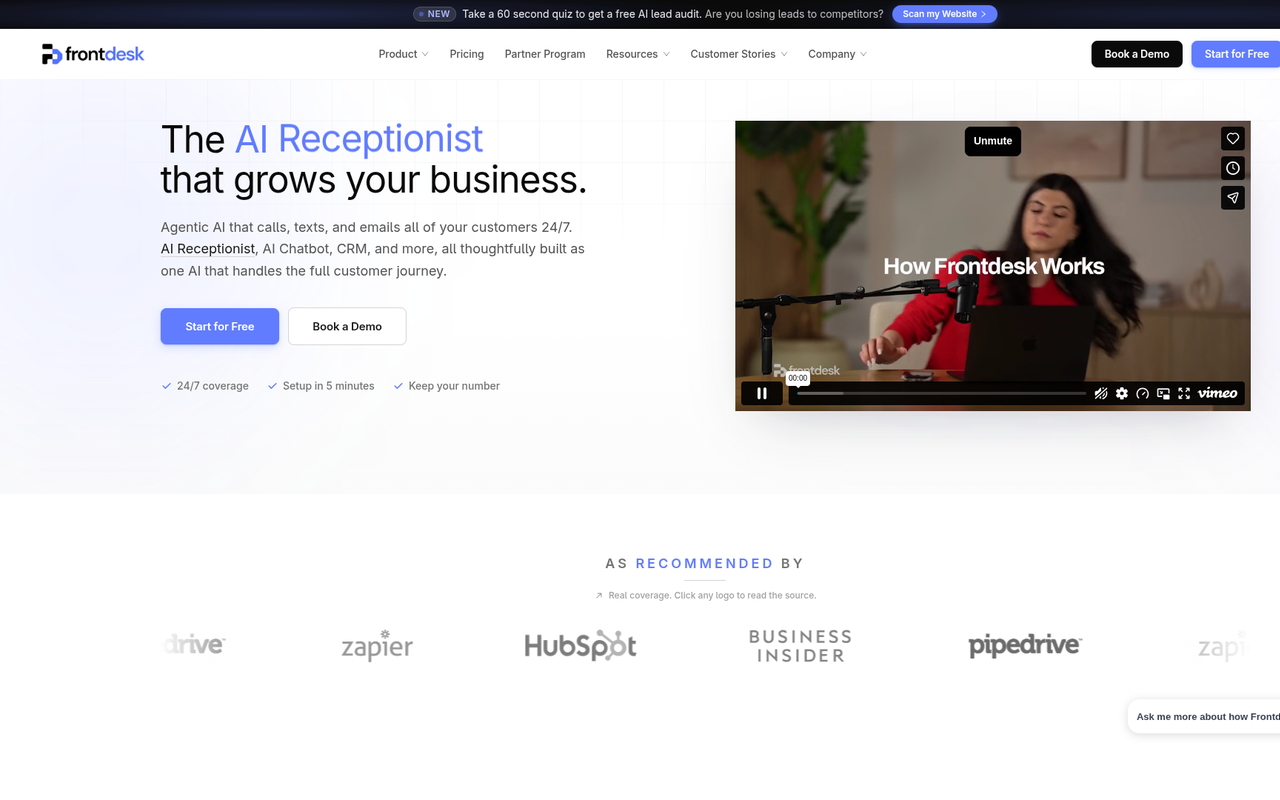
Missed calls are quiet losses. The caller doesn’t leave a voicemail; they call the next business on the list. AI Front Desk puts an AI receptionist on your line so that stops happening at 7pm, during lunch rushes, and whenever your staff is already on the other line.
What it does
It answers, handles routine questions, books appointments against your calendar, sends text follow-ups, and captures caller details for your CRM. Deployment is quick compared with building call automation on contact-center infrastructure.
The fine print
This augments a reception workflow; it is not an enterprise contact-center replacement, and it doesn’t pretend to be. The experience is also only as good as its configuration. Put real effort into the scripts and edge cases up front, because callers will find the gaps for you otherwise.
When it makes sense
When inbound volume exceeds staff capacity and a missed call has a price you can name: a lost booking, an unanswered lead, a frustrated customer. Operations and customer-experience leads usually make this call, and it’s often deployed without touching core AI functions at all.
Our take
A focused tool with a clear job. Adopt it to stop losing calls. Don’t ask it to re-platform your customer service, because that isn’t what it’s for.
What it costs
Published plans (as of August 2026): Basic at $20/month ($16 annual — chat and SMS only, no voice minutes) and Business-in-a-Box at $99/month ($79 annual) with 200 voice minutes, 100 chat conversations, and 400 SMS, plus a custom Partner/Enterprise tier with volume rates. Overages are credit-metered at a cent per credit, which works out to about $0.25 per voice minute, $0.04 per SMS, and $0.05 per chat — model that number, not the sticker, if your call volume is real. 7-day trial, no long-term contracts.
Pros and cons
Where it wins
- Answers around the clock — missed calls become booked appointments
- Voice, chat, SMS, and CRM capture in one product
- Days-not-months deployment vs contact-center builds
- Cheap trial and monthly terms; low commitment risk
Where it hurts
- Governance and compliance tooling is thin versus enterprise contact-center platforms
- Experience quality depends heavily on upfront script and edge-case work
- Voice minutes on the $99 plan run out fast at real call volume — model the overages
Alternatives to consider
Smith.ai and Ruby staff human (or hybrid) receptionists at a much higher monthly cost. Full contact-center platforms (Five9, Genesys) are a different weight class. AI Front Desk is the low-friction middle for SMB-to-mid-market inbound volume.
Frequently asked questions
Is AI Front Desk worth it in 2026?
If missed calls have a price you can name — lost bookings, unanswered leads — yes, at $99/month it pays for itself quickly. It augments reception; don’t expect an enterprise contact-center replacement.
What does AI Front Desk cost?
Basic $20/month (no voice); Business-in-a-Box $99/month with 200 voice minutes and overage credits at a cent each; custom Partner/Enterprise tier with volume rates. 7-day trial, 20% off annually, no long-term contracts.
AI receptionist vs human answering service?
Human services like Smith.ai or Ruby cost several times more per month and still have hours limits. The AI answers instantly, 24/7, at flat cost — but invest real effort in scripts and edge cases, because callers will find the gaps.
Transparency: EnterpriseAI.app may receive referral revenue if you sign up through links on this page, at no additional cost to you. Evaluations are completed before referral relationships are considered — see our methodology and disclosure.