 Enterprise AI Platforms
Relevance.ai Review (2026): AI Agent Orchestration for Enterprise Teams
Reviewed and last updated: . Pricing checked against the vendor’s published plans at review time.
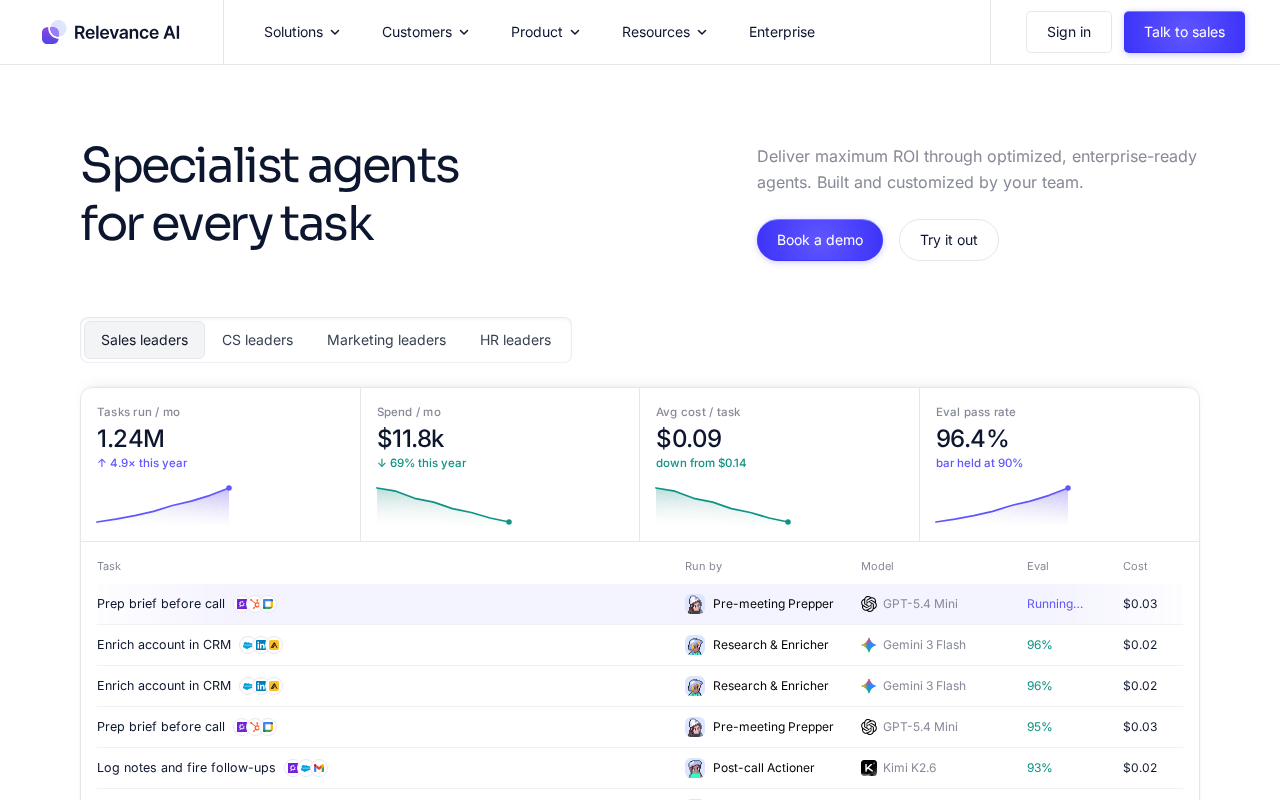
Most companies trying to “deploy AI agents” end up with a pile of disconnected chatbots and a few clever automations that live in one person’s account. Relevance.ai is built for the step after that: you define agents with actual roles, give them tools and data, and wire them together so work moves through them the way it would move through a team.
That framing matters. The product assumes you can describe your process. If you can, it will run that process consistently, which is the whole point of putting agents in production rather than in a demo.
What you’re buying
A low-code environment where operations people, not just engineers, assemble and adjust agent workflows. Agents connect to your existing systems and to automation hubs like Zapier, Make, and n8n, so it lands on top of infrastructure you already run instead of asking you to replace it.
Where it’s strong
Orchestration is the core of the product, not a feature bolted onto a chat window. Roles, hand-offs, and tool access are first-class concepts. Teams that already know their workflows cold can encode them quickly, and changing an agent’s behavior doesn’t require an engineering ticket.
What to watch
Agent orchestration is a young category and the ground is still moving, so expect the product to evolve under you. And the honest caveat: if your organization can’t articulate how a process should work, agents won’t fix that. You’ll also need your own review practices for agent output, because the platform executes whatever logic you give it, good or bad.
Who should decide, and when
This belongs to automation leads and platform teams, with AI strategy stakeholders in the room. It earns its place when tasks need to run consistently across teams and functions, and there’s a real owner treating agent workflows as operational infrastructure rather than a side experiment.
Our take
Of everything we evaluated for the execution-coordination problem, this is the anchor pick. It’s the difference between having AI and having AI that does the work.
What it costs
Relevance.ai’s public pricing page leads with a custom-quoted Enterprise plan: unlimited agents, tools, users, and workforces, 2,000+ integrations, SSO, RBAC, audit logs, agent evaluations and A/B testing, and a dedicated account manager. There are no self-serve price points published on the pricing page — budget for a sales conversation, with costs driven by usage credits and seats. Verify current terms at relevanceai.com/pricing.
Pros and cons
Where it wins
- Orchestration is the product’s core model: roles, hand-offs, and tool access are first-class
- Low-code building keeps agent changes out of the engineering queue
- Connects to existing stacks (2,000+ integrations, incl. Zapier/Make/n8n hubs)
- Enterprise controls (SSO, RBAC, audit logs) are on the menu, not an afterthought
Where it hurts
- No published self-serve pricing for enterprise terms; expect a sales cycle
- A young, fast-moving category: the product will evolve under you
- Garbage in, garbage out: teams that can’t describe their processes won’t get consistent agents
Alternatives to consider
Zapier and n8n automate workflows well but treat agents as a feature, not the core model; they pair with Relevance.ai more often than they replace it. If your need is narrower, single-purpose tools in our directory may cover it without an orchestration layer.
Frequently asked questions
Is Relevance.ai worth it in 2026?
If your bottleneck is getting AI to run coordinated, repeatable work across teams, yes: it’s our core pick for agent orchestration. If you just need individual automations, a workflow tool like Zapier or n8n is cheaper and simpler.
What does Relevance.ai cost?
Public pricing centers on a custom-quoted Enterprise plan (unlimited agents, users, and workforces, SSO, RBAC, audit logs). There are no self-serve price points on its pricing page, so expect a sales conversation with usage-based terms.
What’s the difference between Relevance.ai and Zapier?
Zapier automates predefined workflows between apps; Relevance.ai coordinates AI agents that carry out roles within those workflows. Most enterprises run both: an automation backbone plus an orchestration layer on top.
Transparency: EnterpriseAI.app may receive referral revenue if you sign up through links on this page, at no additional cost to you. Evaluations are completed before referral relationships are considered — see our methodology and disclosure.